Key Summary
Rising manpower costs do not always mean you need another full-time employee. Before opening a new job vacancy, Singapore SMEs can audit the role, break the workload into individual tasks, and decide what should stay internal, be automated, outsourced, or eliminated. In this guide, we explain a practical job redesign framework and where flexible manpower from HiFlyer can fit.
Does every workload gap require a new permanent employee?
When a Singapore SME becomes busier, the usual response is to look for another employee. However, the real problem may be more specific. Perhaps one employee is spending hours on repetitive administration, another is handling a short-term campaign, or the business needs extra manpower only during certain periods.
According to the Singapore Business Federation’s National Business Survey 2025, rising manpower costs remained the top manpower challenge, with 65% of businesses identifying it as a concern. The survey also found that 35% of businesses were outsourcing to local third-party contractors as part of their manpower strategy. At the same time, 30% had implemented job redesign in the previous 12 months.

This suggests that SMEs have more options than simply increasing headcount. A useful starting point is to take one role or department, list the actual tasks being performed, and place each task into the most suitable category. The goal is to understand what work genuinely requires an internal employee and what work could be handled differently.
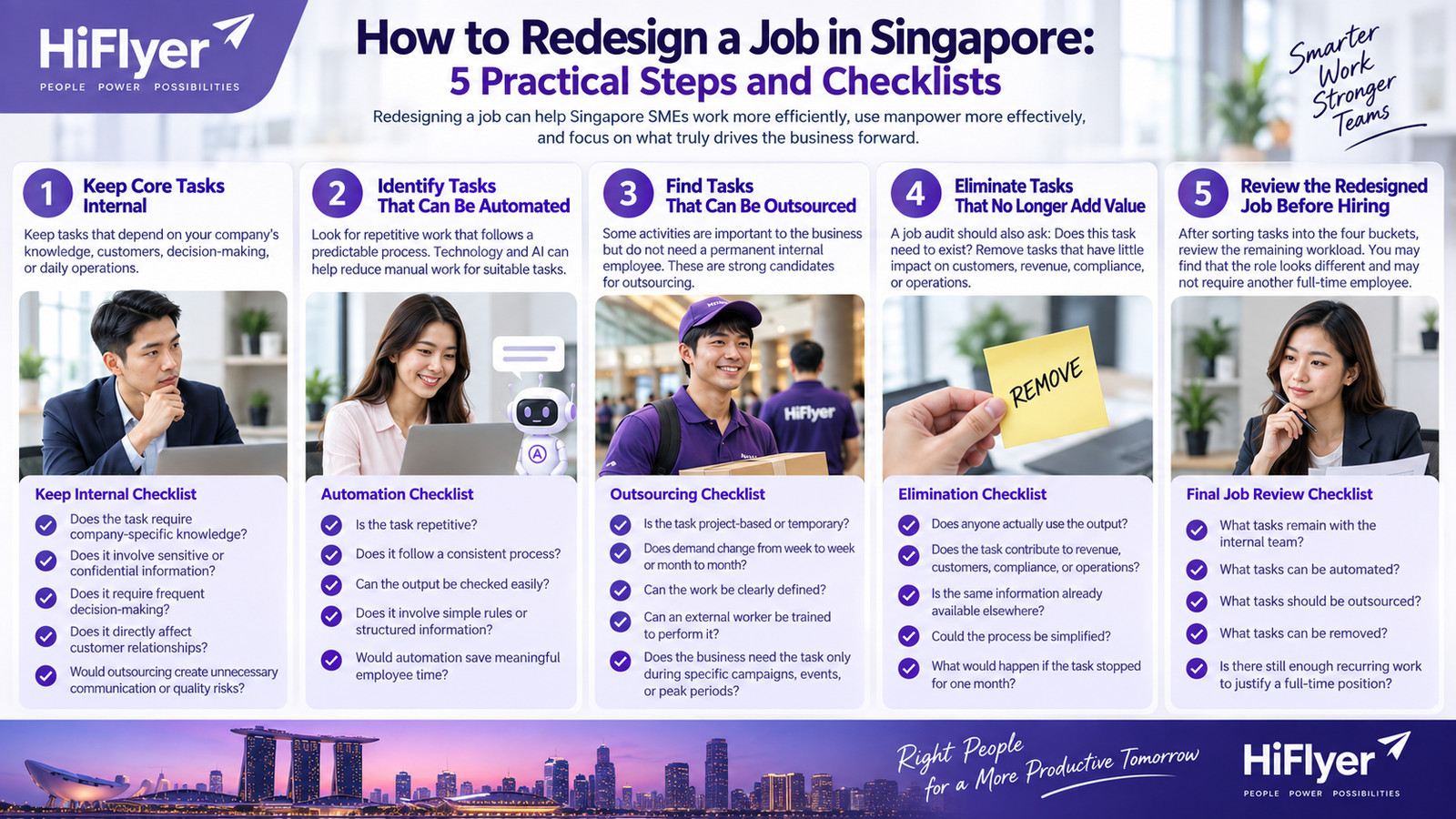
How to Redesign a Job in Singapore: 5 Practical Steps and Checklists
Job redesign can sound like a major organisational project, but SMEs can start much smaller. Pick one role that is overloaded, expensive, difficult to fill, or frequently affected by changing workloads. Then review the work task by task.
The Ministry of Manpower of Singapore has also highlighted job redesign as a way for businesses to improve workforce effectiveness and manage staffing needs. The SkillsFuture Workforce Development Grant (Job Redesign+), or WDG(JR+), provides funding support of up to 70% for qualifying workforce transformation and job redesign project costs, capped at S$150,000 per enterprise, with higher support levels for SMEs.

Use the following five-step process to audit a role:
Step 1: Keep Core Tasks Internal
Start by identifying tasks that directly depend on your company’s knowledge, customers, decision-making, or daily operations. These are often the responsibilities that should remain with your internal team.
For example, a Singapore F&B business may want its managers to handle supplier decisions and customer complaints, while a professional services firm may keep client strategy and confidential work within its core team.
Keep Internal Checklist
- Does the task require company-specific knowledge?
- Does it involve sensitive or confidential information?
- Does it require frequent decision-making?
- Does it directly affect customer relationships?
- Would outsourcing create unnecessary communication or quality risks?
If most answers are yes, keeping the task internally may make more sense.

Step 2: Identify Tasks That Can Be Automated
Next, look for repetitive work that follows a predictable process. This could include appointment reminders, simple data entry, recurring reports, scheduling, document processing, or basic customer notifications.
Technology can sometimes reduce the amount of manual work required. AI can also be one option for suitable repetitive tasks, although SMEs should first assess whether the process is stable, measurable, and appropriate for automation.
Automation Checklist
- Is the task repetitive?
- Does it follow a consistent process?
- Can the output be checked easily?
- Does it involve simple rules or structured information?
- Would automation save meaningful employee time?
If the task requires frequent human judgement, relationship management, or physical activity, another solution may be more appropriate.

Step 3: Find Tasks That Can Be Outsourced
Some activities are important to the business but do not need to be performed by a permanent internal employee. These are strong candidates for outsourcing.
Think about activities such as flyer distribution, event promotion, survey collection, temporary booth support, moving and general labour, or other project-based work. The business may need these services for a campaign or specific period without having enough ongoing work to justify another full-time role.
Outsourcing Checklist
- Is the task project-based or temporary?
- Does demand change from week to week or month to month?
- Can the work be clearly defined?
- Can an external worker be trained to perform it?
- Does the business need the task only during specific campaigns, events, or peak periods?
If yes, outsourcing can allow the SME to access manpower when the workload requires it.

Step 4: Eliminate Tasks That No Longer Add Enough Value
A job audit should also ask a question that is often overlooked:
Does this task need to exist?
Employees can spend significant time maintaining reports nobody reads, repeating manual processes because “that is how we have always done it”, attending meetings without clear outcomes, or completing administrative work that has little impact on customers or revenue.
Elimination Checklist
- Does anyone actually use the output?
- Does the task contribute to revenue, customers, compliance, or operations?
- Is the same information already available elsewhere?
- Could the process be simplified?
- What would happen if the task stopped for one month?
If removing a task creates little or no business impact, eliminating it may be more effective than finding someone else to perform it.

Step 5: Review the Redesigned Job Before Hiring
After sorting tasks into the four buckets, look at the remaining workload again. This is where the audit becomes useful.
You may discover that the original full-time role has changed significantly. A role that appeared to require another employee may actually need a combination of internal ownership, automation, outsourced support, and occasional flexible manpower.
Final Job Review Checklist
- What tasks remain with the internal team?
- What tasks can be automated?
- What tasks should be outsourced?
- What tasks can be removed?
- Is there still enough recurring work to justify a full-time position?
The Ministry of Manpower of Singapore has also noted that SMEs commonly face operational constraints because they have leaner staffing and less scope to redistribute work when employees need different working arrangements. MOM specifically points to Job Redesign+ and productivity solutions as ways businesses can redesign jobs and manage staffing needs.
Where HiFlyer Fits: Flexible Manpower for Outsourced SME Tasks
Once an SME completes a job audit, some tasks may clearly fall into the outsourcing category. This is where flexible manpower can be useful, particularly when a business needs additional support for a specific activity, campaign, location, or period. HiFlyer helps Singapore businesses access trained part-time and flexible manpower for task-based roles such as flyer distributors, promoters, booth assistants, surveyors, sales canvassers, general labour, and other temporary support.

For example, a retail business preparing for a new outlet opening may keep launch planning, store operations, and customer relationships with its internal team while outsourcing flyer distribution around nearby HDB estates. Promoters can support the opening campaign for several days, while surveyors can collect customer feedback during the launch period. These activities can contribute to the campaign without requiring the business to create permanent positions for each task.

The key is matching manpower to the actual work identified during the job audit. HiFlyer supports this process by providing trained workers who are prepared before deployment, helping them understand the campaign requirements, follow the required processes, and carry out their responsibilities effectively. For SMEs, this provides access to flexible manpower when specific tasks require additional support, while keeping the core responsibilities within the internal team.
Redesign the Work Before Increasing the Headcount
Hiring remains an important solution when a business has a genuine, recurring workload that requires a permanent employee. However, a job audit can help Singapore SMEs understand the workload first and decide whether additional headcount is actually necessary. By reviewing each task individually, businesses can make hiring decisions based on the work required rather than simply reacting to a busy period.
For some SMEs, the audit may confirm that a full-time employee is needed. For others, it may reveal that certain tasks can be automated, eliminated, outsourced, or handled by flexible manpower. SBF’s 2025 survey found that 30% of businesses had implemented job redesign in the previous 12 months, while 35% had outsourced to local third-party contractors as part of their manpower strategies. This shows that reviewing how work is structured is already part of how businesses are responding to manpower pressures.
Which task in your business would you outsource first if you could remove it from your team’s workload? Comment “JOB AUDIT” and tell us your business type and the task you are considering. We would love to hear how Singapore SMEs are redesigning their jobs and share ideas on whether that task may be better suited for internal staff, automation, outsourcing, or flexible manpower.
Q&A: Job Redesign and Hiring Costs for Singapore SMEs
What is a job redesign for an SME?
Job redesign means reviewing the tasks within an existing role and changing how the work is organised, performed, or allocated. For SMEs, this can involve keeping core work internal, automating repetitive tasks, outsourcing suitable activities, and removing unnecessary work. The aim is to make the role more productive and ensure that each task is handled in the most suitable way.
Why is job redesign relevant to Singapore SMEs?
Singapore SMEs often operate with leaner teams, which can make it difficult to redistribute work when workloads change or employees require different working arrangements. MOM has noted that leaner staffing and limited scope to redistribute work are among the operational constraints faced by SMEs. Job redesign can help businesses review their existing work and find more practical ways to manage staffing needs.
What is the SkillsFuture Workforce Development Grant (Job Redesign+)?
The SkillsFuture Workforce Development Grant (Job Redesign+), or WDG(JR+), is a Singapore government grant that supports companies undertaking workforce transformation and job redesign projects. From March 2026, the grant provides funding of up to 70% of qualifying project costs, capped at S$150,000 per enterprise, with higher support levels for SMEs. It replaced the previous Productivity Solutions Grant-Job Redesign (PSG-JR) support.
How much can Singapore SMEs receive under WDG(JR+) from The Ministry of Manpower?
For SMEs, WDG(JR+) provides funding support of up to 70% for qualifying job redesign and workforce transformation project costs, subject to the applicable funding scope and the overall S$150,000 per enterprise cap. The enhanced support is significantly higher than the previous PSG-JR funding cap of S$30,000.
What can WDG(JR+) support?
The grant can support more than simply reviewing job descriptions. MOM states that WDG(JR+) can support workforce consultancy, capability building for line managers and HR teams, and identifying workforce solutions and technology tools. The consultancy scope can include assessing workforce needs, diagnosing business processes, and redesigning job roles.
Can job redesign help SMEs manage flexible work arrangements?
Yes. MOM states that SMEs can use WDG(JR+) to redesign jobs so that roles and work processes can better accommodate employees across different life stages and caregiving responsibilities. Job redesign can therefore be considered alongside flexible work arrangements when SMEs review how work is structured.
Does job redesign mean reducing employees?
Not necessarily. Job redesign can also help employees focus on higher-value responsibilities by removing repetitive or unnecessary work, improving processes, or changing how tasks are allocated. MOM’s job redesign support is intended to help businesses transform jobs and improve workforce productivity while supporting workforce development.
Can AI be part of job redesign?
Yes. AI can be considered as one option for repetitive and structured tasks. MOM’s WDG(JR+) framework includes identifying technology tools and workforce solutions as part of transformation efforts. However, SMEs should assess the task first because some activities require human judgement, communication, physical presence, or customer interaction.
When should a Singapore SME consider outsourcing instead?
Outsourcing can be considered when a task is project-based, temporary, seasonal, campaign-specific, or does not generate enough recurring work to justify a permanent position. Examples include flyer distribution, event promotion, survey collection, booth assistance, sales canvassing, moving, and general labour.
Can HiFlyer help after an SME completes a job audit?
Yes. When an SME identifies suitable tasks for outsourcing or flexible manpower, HiFlyer can provide trained part-time workers for suitable roles such as flyer distribution, promotion, booth assistance, surveying, sales canvassing, and other temporary campaign support.
What should an SME do before opening a new job vacancy?
Start by listing the actual tasks involved. Then review how often each task occurs, how important it is, whether it can be automated, whether it can be outsourced, and whether it needs to remain internal. Only after that should the business decide whether a new permanent role is necessary.